back

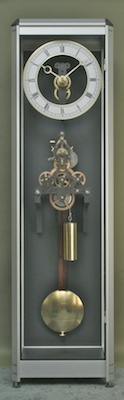
Auto-winded. Movement with one-minut-remontoir. 1,98 x 0,55 x 0,40 mtr. 
The movement is a special edition of a Ungerer or Schwilgue from Strasbourg, ca. 1890 and has a so called 'remontoir'. The escapement is driven by a spring, that is winded every minute by the weight. The forces on the Graham escapement are now constant (force constant). 
The automated winding system is hidden under and behind the clockcase. The winding happens every 4 to 5 hours and takes circa 20 seconds. 
The case is made of high quality anodic treated aluminium with 8 mm glass in the sides and a 6 mm glass door. 
The antique hands-system is driven by the movement on the back of the clock.
The electronics need 220 V.
4665

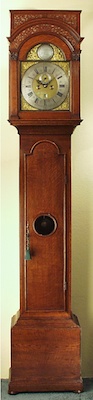
Dutch musical longcase clock, signed: 'Jacobus van der Hegge, Den Haag', ca 1750. Dutch striking and musical: 15 hamers on 8 bells, 4 melodies. height 2,80 mtr
2302 SOLD

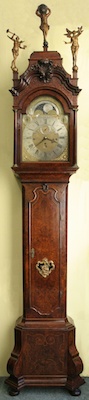
Case: oak, walnut veneered, checker-work patterned bandings, cuboid, moulded base, 4 lavishly decorated, gadrooned bun feet, oblong middle-part with lobed front door and applied gilt shell-work, concave neck with carved, gilt mask. Overlapping oblong top, glazed on three sides, bow-shaped dial aperture flanked by two solid angled pillars with Corinthian capitals, circumferential gilt strapwork, terrace-shaped square aedicule with pierced and richly ornamented sides, angles crowned by four gilt vases, height 2960 mm. Dial: brass, solid silver corner spandrels with applied pierced foliate pattern, applied silvered chapter ring with radial Roman numerals, silvered circlet for auxiliary seconds at
2105 € 34.000 + BTW

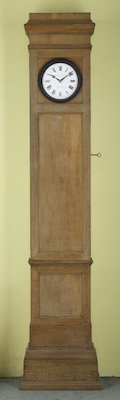
Belgian longcase clock, signed 'Jacobus Willemore Anvers', ca. 1725, goes 55 days. height 2,50 mtr. Jacobus Willemore was working in Antwerp and in Mechelen (Malines).
0214


back